The Cascading Network of Climate Feedbacks and Tipping Points: From Polar Amplification to Planetary Rotation
This is what is happening right now. And with every reinforcing feedback we activate, we amplify what comes next.
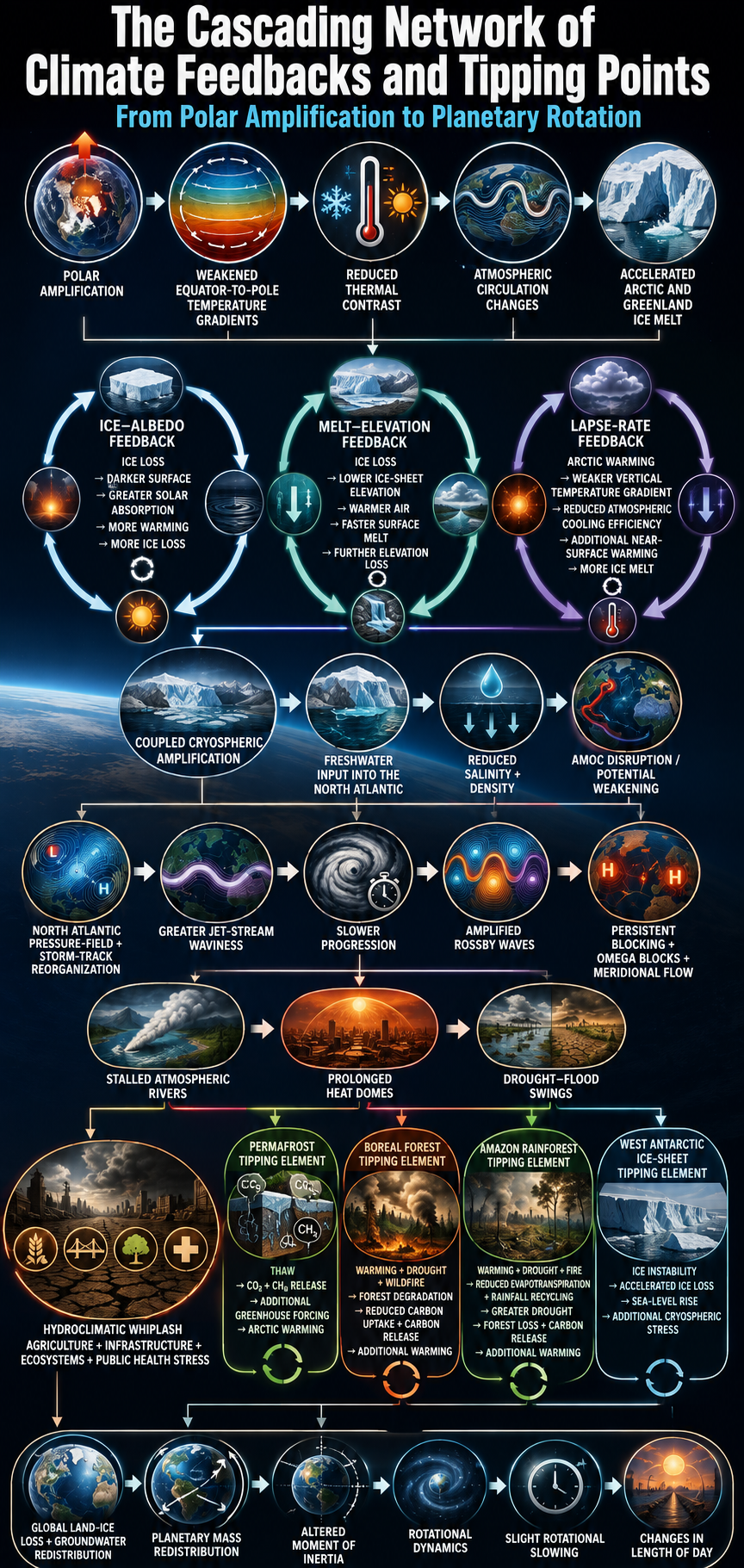
Polar amplification → weakened equator-to-pole temperature gradients → reduced thermal contrast → atmospheric circulation changes → accelerated Arctic and Greenland ice melt → ICE–ALBEDO FEEDBACK: ice loss → darker surface → greater solar absorption → more warming → more ice loss ↺ → MELT–ELEVATION FEEDBACK: ice loss → lower ice-sheet elevation → warmer air → faster surface melt → further elevation loss ↺ → LAPSE-RATE FEEDBACK: Arctic warming → weaker vertical temperature gradient → reduced atmospheric cooling efficiency → additional near-surface warming → more ice melt ↺ → coupled cryospheric amplification → freshwater input into the North Atlantic → reduced salinity + density → AMOC disruption / potential weakening → North Atlantic pressure-field + storm-track reorganization → greater jet-stream waviness → slower progression → amplified Rossby waves → persistent blocking + omega blocks + meridional flow → stalled atmospheric rivers + prolonged heat domes + drought–flood swings → hydroclimatic whiplash → agriculture + infrastructure + ecosystems + public health stress → PERMAFROST TIPPING ELEMENT: thaw → CO₂ + CH₄ release → additional greenhouse forcing → Arctic warming ↺ → BOREAL FOREST TIPPING ELEMENT: warming + drought + wildfire → forest degradation → reduced carbon uptake + carbon release → additional warming ↺ → AMAZON RAINFOREST TIPPING ELEMENT: warming + drought + fire → reduced evapotranspiration + rainfall recycling → greater drought → forest loss + carbon release → additional warming ↺ → WEST ANTARCTIC ICE-SHEET TIPPING ELEMENT: ice instability → accelerated ice loss → sea-level rise → additional cryospheric stress → global land-ice loss + groundwater redistribution → planetary mass redistribution → altered moment of inertia → rotational dynamics → slight rotational slowing → changes in length of day.
Also see:
- The Arctic Amplification Engine
- The Ice–Albedo–Melt–Elevation Feedback: Earth’s Most Powerful Cryospheric Tipping-Point Mechanism
- Arctic Amplification: Arctic Heat, Wildfires, and the Accelerating Loss of Earth’s Ice
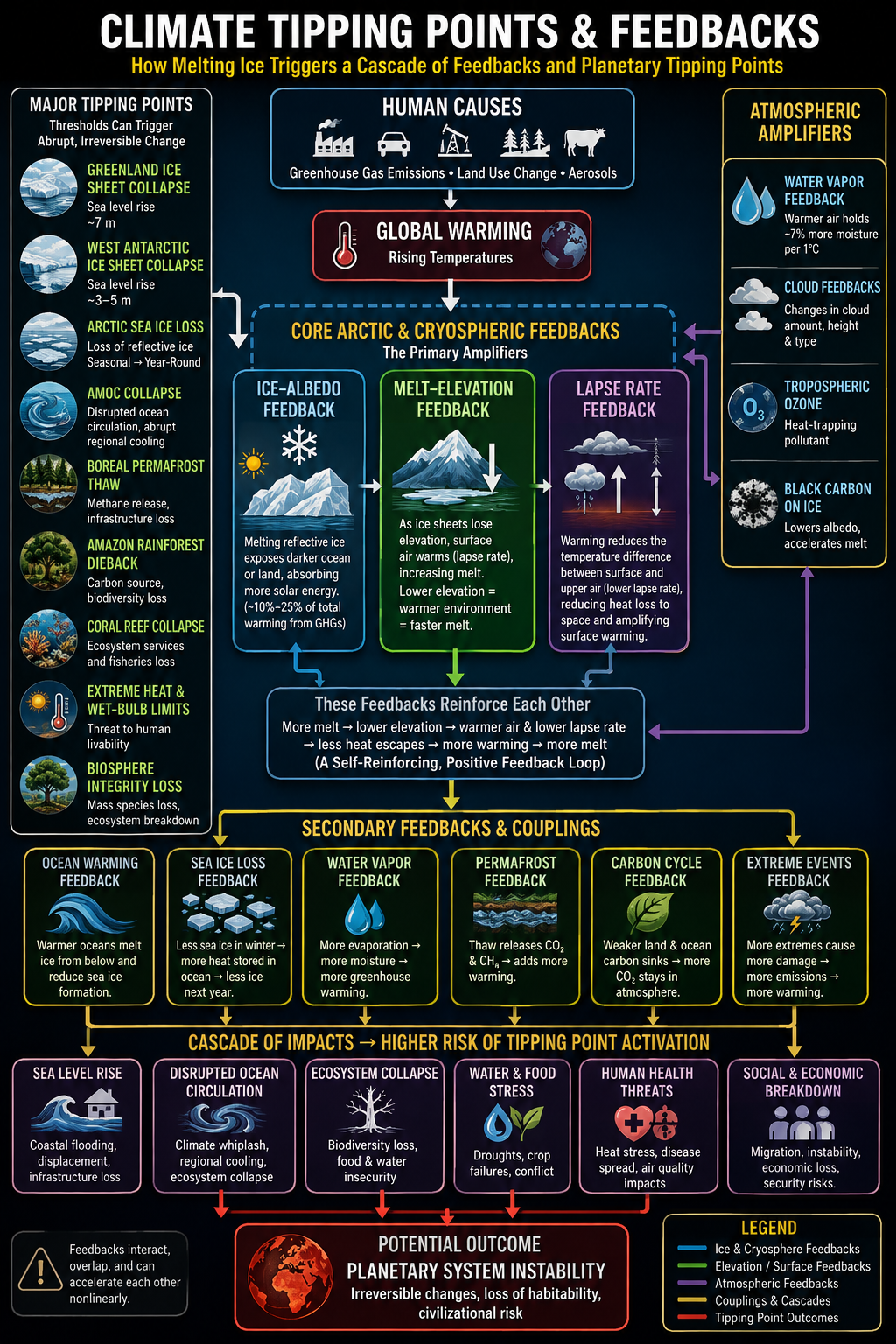
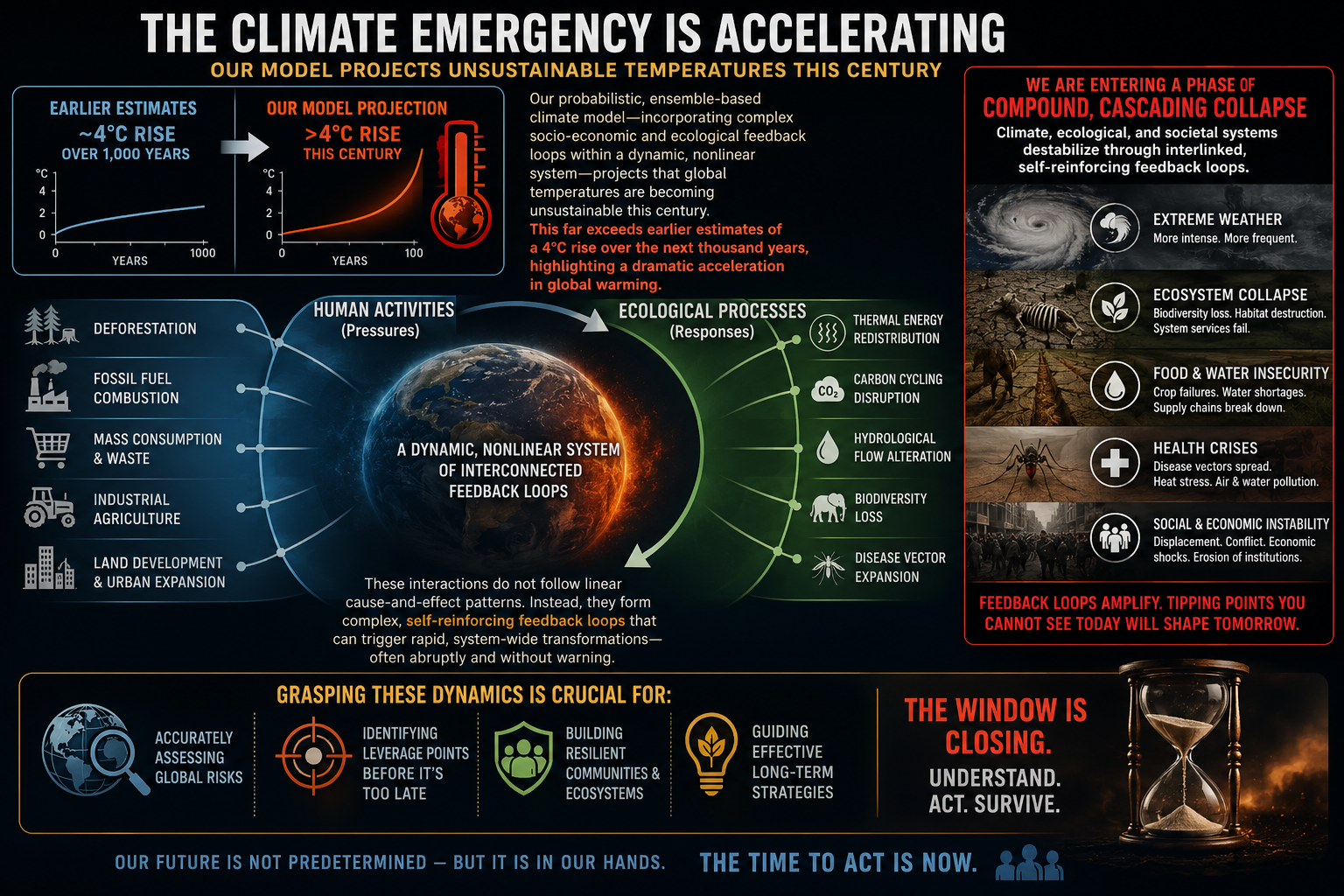
Extreme Impacts: Extreme Weather Events | Violent Rain | Deadly Humid Heat | Sea Level Rise | Insurance
Ecosystems & Feedbacks: Ecosystem Collapse & Extinction Risks | Soil–Insect Climate Feedback Collapse | Insect Collapse | Soil | Trees & Deforestation
Human Health & Society: Climate Change Business & Economics | DIY Climate Control | Climate & Human Health | Climate Tax | Limits of Human Adaptability | Climate-Driven Health Collapse | Food & Water Security | Civilization Collapse