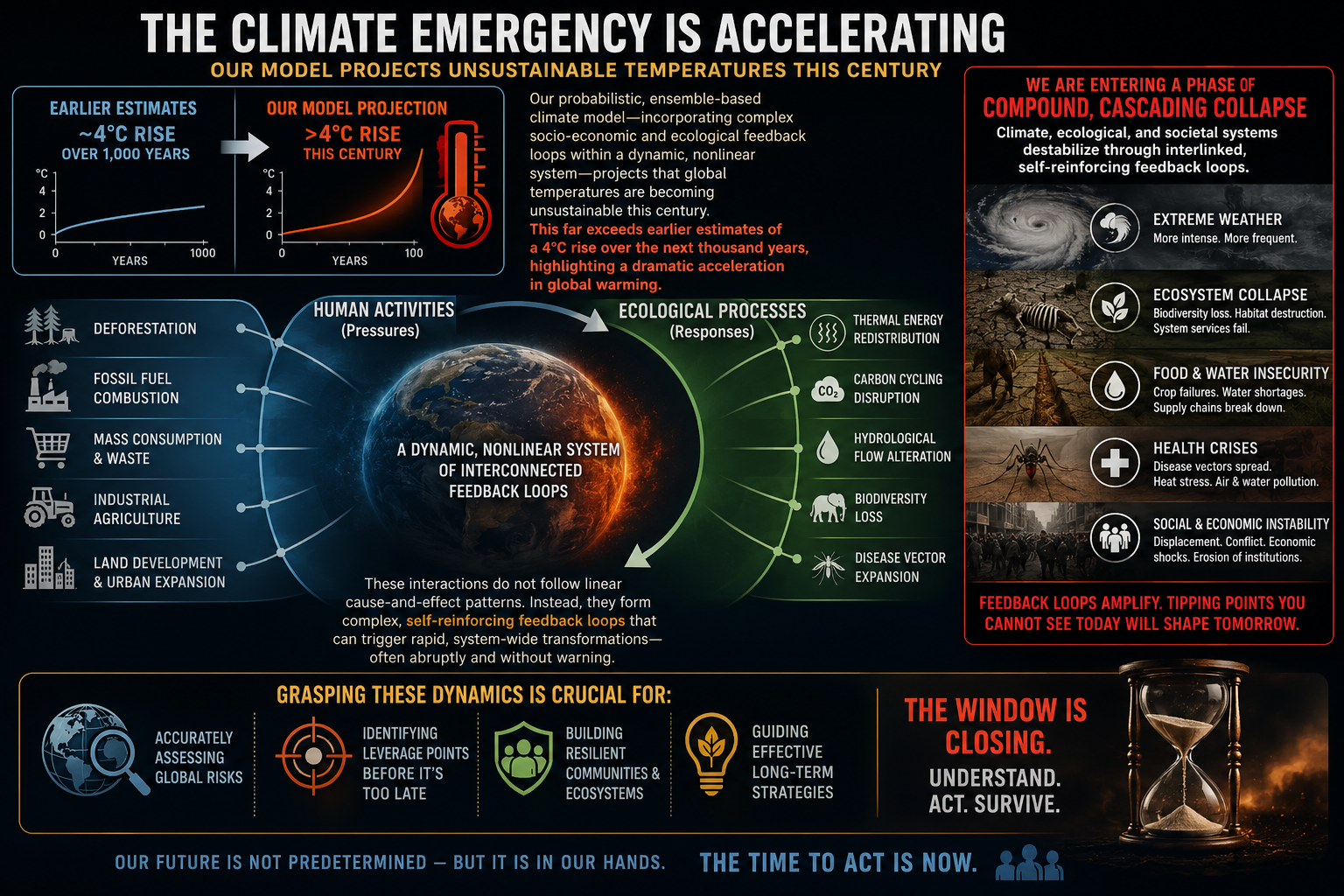
Coupled Climate Feedbacks: How Tipping Points Trigger Cascading Earth-System Instability
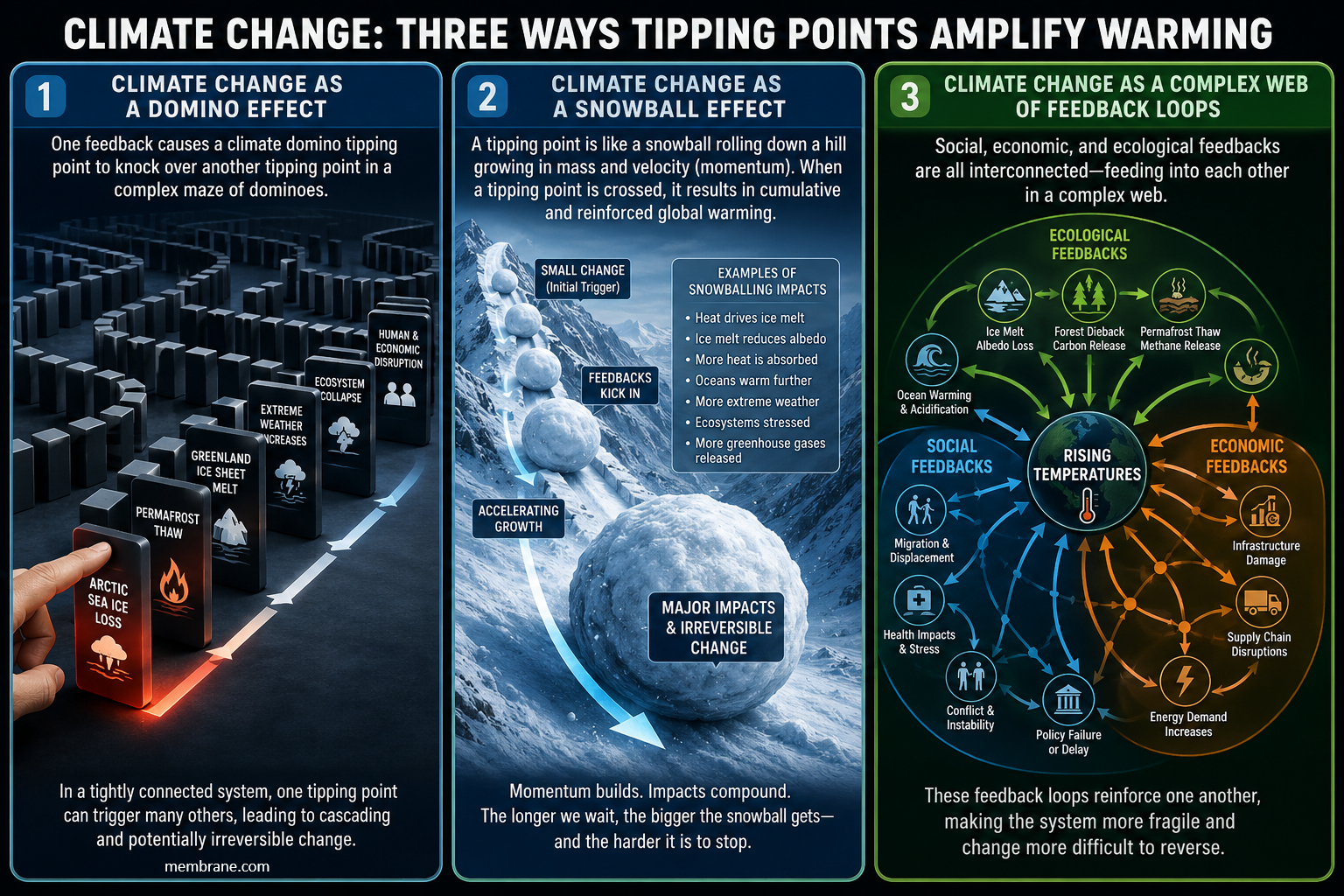
The Domino Effect
Warming → Feedback Activation → Feedback Coupling → Amplification → Tipping-Point Threshold → CascadeThe climate system is not simply warming—it is changing how it responds to that warming. Coupled climate feedbacks are becoming one of the most consequential dimensions of climate risk in the 21st century because they amplify changes and connect individual tipping-point pathways into larger cascading effects.
The longer warming persists, the more climate feedbacks become active. As these feedbacks interact, we are already observing nonlinear responses, amplification, and cascading impacts across the climate system. Hundreds of feedback mechanisms have been identified, and many can couple and reinforce one another, contributing to the accelerating pace and increasing magnitude of climate change.
1Independent Climatologist, Economist, Membrane Domain, USA
2Independent Physicist, Membrane Domain, USA
From Tipping Elements to Cascading Feedbacks
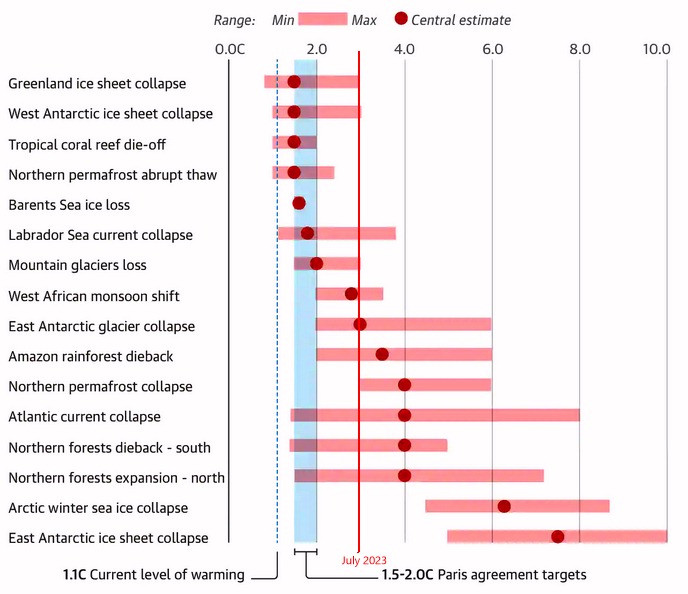
In 2008, a landmark climate-science paper, “Tipping Elements in the Earth’s Climate System,” brought renewed attention to the possibility that major components of the Earth system could undergo abrupt and potentially irreversible changes once critical thresholds were approached or crossed.
The 2008 Foundational Paper
Tipping Elements in the Earth’s Climate System
Lenton et al. (2008), Proceedings of the National Academy of Sciences
The paper examined several major climate tipping elements and highlighted the potential significance of warming in the range of approximately 1.5–2°C above preindustrial levels. These findings helped reinforce the scientific rationale for limiting global warming, including through the Paris Agreement’s goal of holding warming well below 2°C while pursuing efforts to limit it to 1.5°C.
At the time, the central challenge was framed largely as one of preventing individual climate tipping elements from reaching critical thresholds.
By July 2023, the climate system was experiencing extraordinary temperature anomalies, with some regions reaching as much as 3°C above preindustrial levels. Multiple indicators of climate-system stress were already visible, including extensive wildfires across Canada and Siberia, widespread permafrost thaw, and persistent underground fires—so-called “zombie fires”—that continued to smolder through the Arctic winter.
Today, the scientific picture is becoming more complicated.
Evidence of accelerating changes in several vulnerable components of the Earth system has intensified concern about not only approaching but crossing thresholds. What was less well understood in the earlier tipping-point framework was the possibility that multiple feedback loops could interact, reinforce one another, and alter the timescales over which destabilization occurs.
The critical question is no longer simply:
How close is each tipping point?
It is increasingly:
What happens when tipping elements and feedback loops begin interacting with one another?
The Missing Dimension: Coupled Feedback Loops
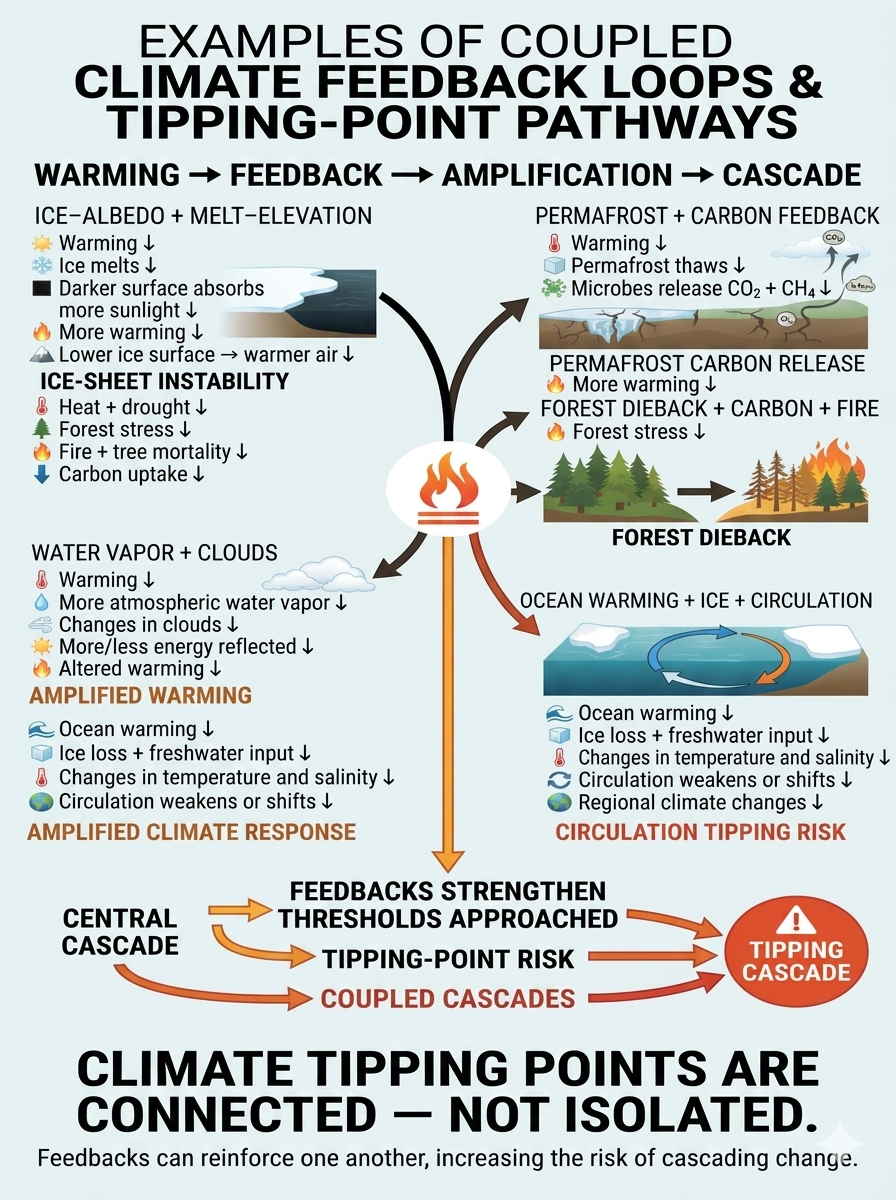
In the 1990s, research associated with the Membrane Domain began exploring human-induced climate change through a nonlinear systems perspective, challenging the assumption that climate impacts would necessarily progress in a simple, approximately linear fashion.
Our research proposed that climate change could exhibit nonlinear and accelerating behavior as multiple physical, ecological, and socioeconomic feedbacks interact. The central concept was not that warming itself follows a simple exponential curve, but that the rate and consequences of change can accelerate as reinforcing feedbacks become increasingly coupled.
At the heart of this possibility are positive feedback mechanisms.
In climate science, a positive feedback is a process in which an initial change produces additional changes that reinforce the original disturbance. The term “positive” describes the direction of the feedback, not whether its consequences are beneficial.
Examples include:
- Ice–Albedo Feedback — loss of reflective snow and ice exposes darker surfaces that absorb more solar energy.
- Water Vapor Feedback — warming increases atmospheric water vapor, strengthening greenhouse trapping.
- Carbon-Cycle Feedbacks — warming can alter soils, vegetation, oceans, and permafrost in ways that affect carbon uptake and release.
- Ocean-Circulation Feedbacks — changes in temperature, salinity, and freshwater input can alter ocean circulation and climate patterns.
- Vegetation–Climate Feedbacks — warming, drought, wildfire, and vegetation loss can reinforce regional drying and carbon loss.
- Cloud Feedbacks — warming alters cloud properties and distributions, changing the balance between reflected sunlight and outgoing infrared radiation.
- Extreme-Weather and Health Feedbacks — heat, wildfire smoke, air pollution, infectious disease risks, and infrastructure disruption can interact with ecological and societal vulnerabilities.
Individually, these mechanisms can amplify warming or its impacts.
The more consequential possibility is that they can also interact.
When Feedbacks Begin Coupling
A feedback loop does not have to operate in isolation.
For example:
Warming → Sea-Ice Loss → Lower Albedo → Greater Solar Absorption → Additional Arctic Warming
At the same time:
Arctic Warming → Permafrost Thaw → Microbial Decomposition → Greater Greenhouse-Gas Release → Additional Atmospheric Warming
These pathways can interact.
Additional warming can increase ice loss, which can alter atmospheric and oceanic conditions. Those changes can influence permafrost, ecosystems, circulation, precipitation, and wildfire behavior. Each affected subsystem can then introduce additional feedbacks.
The result is not necessarily one feedback loop.
It is a network of interacting feedback loops.
Tipping Points Can Become Connectors
Climate tipping points are often discussed individually: Greenland ice loss, Antarctic ice-sheet instability, AMOC disruption, Amazon dieback, permafrost thaw, and other vulnerable components.
But Earth systems do not operate independently.
When one component undergoes a major transition, the resulting changes can modify the conditions experienced by other components.
A tipping element can therefore become more than an endpoint.
It can become a connector.
A threshold crossing can alter temperature, precipitation, ocean salinity, atmospheric circulation, carbon exchange, surface reflectivity, or other physical conditions. Those changes can increase stress on another vulnerable subsystem.
This creates the possibility of cascading interactions:
Initial Warming
→ Feedback Amplification
→ Tipping-Element Destabilization
→ Environmental Change
→ New Feedback Activation
→ Additional Tipping-Element Stress
→ Further Amplification
The system can begin moving through a sequence in which each major disturbance increases the probability or severity of subsequent disturbances.
Tipping Points Igniting a Domino Effect
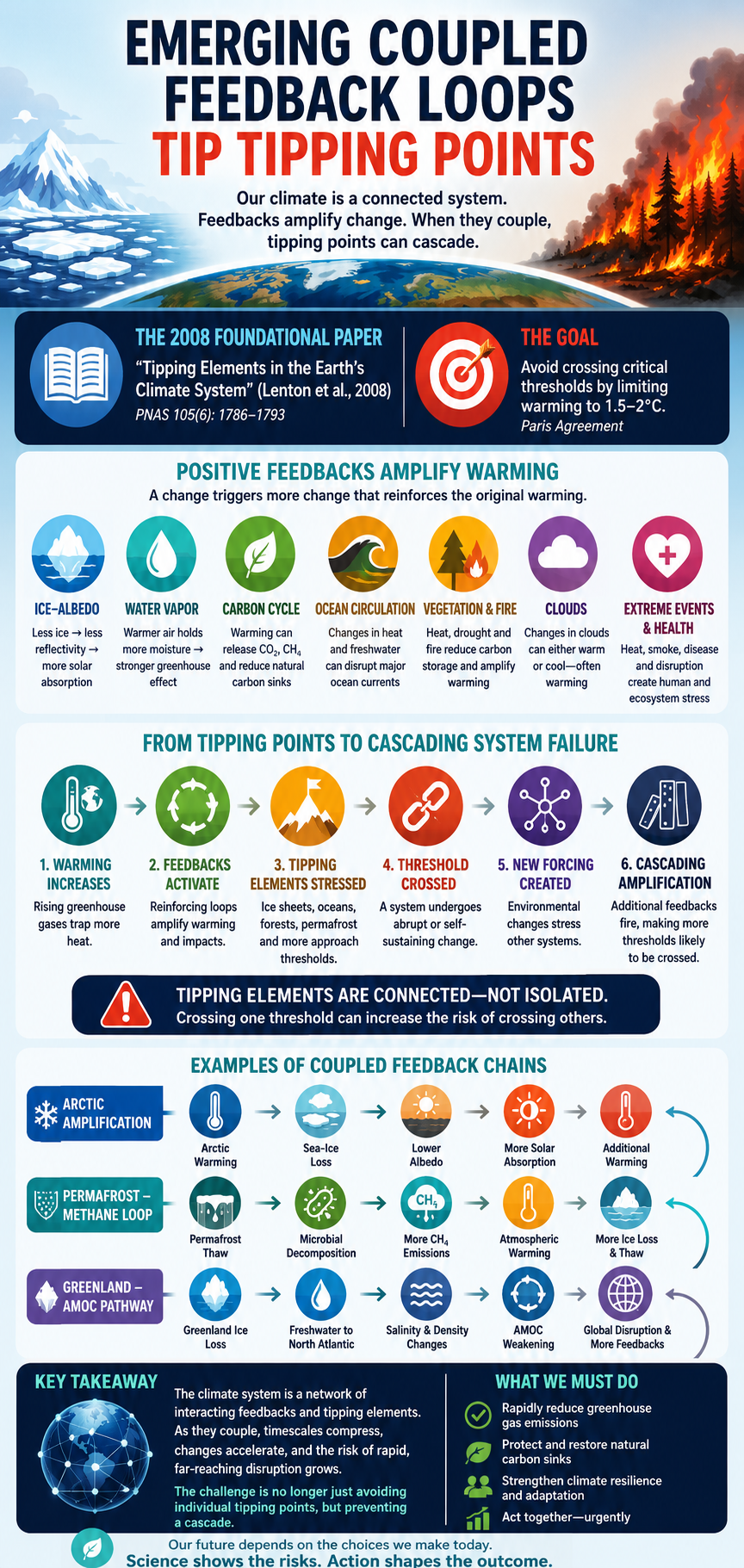
We understood that tipping points could eventually activate self-reinforcing feedbacks within the climate system.
What has become increasingly difficult to ignore is the potential importance of coupling and timescale compression.
The concern is not simply that individual thresholds exist.
It is that interacting feedbacks can change how quickly the system approaches them.
Consider a simplified example involving the Arctic:
Arctic Warming
→ Snow and Sea-Ice Loss
→ Lower Surface Reflectivity
→ Greater Solar Absorption
→ Additional Arctic Warming
At the same time:
Arctic Warming
→ Permafrost Thaw
→ Microbial Decomposition
→ Increased Methane and Carbon Release
→ Additional Atmospheric Warming
And simultaneously:
Arctic Warming
→ Atmospheric-Circulation Changes
→ Heat Extremes and Drought
→ Boreal Forest Stress
→ Wildfire
→ Carbon Emissions and Smoke Effects
These are not three isolated climate stories.
They are interacting components of a larger Earth-system network.
Cascading System Failures
The destabilization of climate subsystems is unlikely to resemble a smooth, uniform decline.
Instead, some changes can increase stress on other systems, producing cascading and compounding effects.
Consider the interaction between ocean circulation, Greenland, the Arctic, and the carbon cycle.
Changes in the Atlantic Meridional Overturning Circulation (AMOC) can redistribute heat and influence precipitation patterns across the Atlantic basin. Meanwhile, Greenland ice loss adds freshwater to the North Atlantic, affecting ocean density and stratification and potentially contributing to further AMOC weakening.
At the same time, Arctic amplification accelerates sea-ice loss and permafrost thaw. Permafrost degradation can release additional carbon dioxide and methane, adding greenhouse forcing to an already warming atmosphere.
Elsewhere, increasing heat and drought stress can threaten tropical forests. Amazon forest degradation and drought can reduce carbon uptake, alter evapotranspiration and rainfall recycling, and potentially increase the vulnerability of the forest to further drying and fire.
These processes can interact with one another.
The important point is not that every feedback necessarily causes every other feedback.
It is that the Earth system contains enough interconnected pathways that disturbances in one subsystem can propagate into others.
From Isolated Thresholds to a Network of Thresholds
This changes how climate risk should be conceptualized.
A tipping point should not necessarily be viewed as an isolated cliff.
It may be better understood as a node within a dynamic network of interacting thresholds and feedbacks.
The critical sequence becomes:
Warming
→ Feedback Activation
→ System Destabilization
→ Threshold Approach or Crossing
→ New Environmental Forcing
→ Additional Feedback Activation
→ Further Threshold Stress
Under this framework, the risk is not merely that one tipping element crosses a threshold.
The greater concern is cascading destabilization across multiple connected components of the Earth system.
The Central Risk: Nonlinear Acceleration
This is where nonlinear climate dynamics become especially important.
If each climate subsystem responded independently, the trajectory of global change would be easier to anticipate.
But coupled systems can behave differently.
As more feedbacks become activated, the effective rate of change in one component can be influenced by changes occurring elsewhere. This can produce periods of acceleration, abrupt transitions, threshold behavior, and substantial regional differences.
The resulting trajectory does not have to be a smooth curve.
It can become increasingly irregular and nonlinear.
That does not mean that the climate system is literally entering an uncontrolled “runaway” state, nor does it mean that every tipping point will necessarily cascade into every other one.
It means that the possibility of interacting thresholds and feedbacks makes the future more path-dependent, nonlinear, and difficult to manage.
The Climate System Is a Network, Not a Collection of Isolated Problems
The most important conceptual shift may therefore be from thinking about individual climate threats to understanding coupled Earth-system dynamics.
Ice loss affects albedo.
Warming affects permafrost.
Permafrost affects greenhouse-gas concentrations.
Greenhouse gases affect atmospheric warming.
Warming affects ecosystems.
Ecosystem degradation affects carbon storage.
Wildfire affects carbon emissions and atmospheric composition.
Ocean warming affects ice shelves.
Ice-sheet loss affects sea level and freshwater inputs.
Freshwater inputs can affect ocean circulation.
Ocean circulation redistributes heat and influences atmospheric conditions.
And each change can alter the conditions under which other feedbacks operate.
The resulting system resembles less a collection of separate dominoes and more a network of interconnected switches, where activating one pathway can change the sensitivity of many others.
The Real Challenge
The climate problem is therefore not simply about how much warming humanity produces.
It is also about how warming changes the internal dynamics of the Earth system.
The longer warming persists, the more climate feedbacks become active. As these feedbacks interact, we are already observing nonlinear responses, amplification, and cascading impacts across the climate system. Hundreds of feedback mechanisms have been identified, and many are coupling and reinforcing one another, contributing to the accelerating pace and increasing magnitude of climate change.
The scientific challenge is to determine:
Which thresholds are approaching? Which have been crossed?
Which feedbacks are becoming stronger?
Which feedbacks are becoming coupled?
How quickly are these interactions changing the system?
And most importantly:
Are we beginning to compress the timescales between individual climate-system disruptions?
These questions deserve the same urgency once reserved for the identification of individual tipping points.
The climate system is not simply warming.
It is changing how it responds to warming.
That may ultimately prove to be one of the most consequential dimensions of climate risk in the 21st century.
Examples of Coupled Climate Feedback Loops and Tipping-Point Pathways
Climate feedbacks rarely operate in isolation. Many interact with, reinforce, or redirect one another, creating coupled feedback systems in which an initial warming response can trigger additional processes that amplify warming and increase pressure on climate tipping elements.
Top of the World
This is what is happening right now. And with every reinforcing feedback we activate, we amplify what comes next.
Polar amplification → weakened equator-to-pole temperature gradients → reduced thermal contrast → atmospheric circulation changes → accelerated Arctic and Greenland ice melt → ICE–ALBEDO FEEDBACK: ice loss → darker surface → greater solar absorption → more warming → more ice loss ↺ → MELT–ELEVATION FEEDBACK: ice loss → lower ice-sheet elevation → warmer air → faster surface melt → further elevation loss ↺ → LAPSE-RATE FEEDBACK: Arctic warming → weaker vertical temperature gradient → reduced atmospheric cooling efficiency → additional near-surface warming → more ice melt ↺ → coupled cryospheric amplification → freshwater input into the North Atlantic → reduced salinity + density → AMOC disruption / potential weakening → North Atlantic pressure-field + storm-track reorganization → greater jet-stream waviness → slower progression → amplified Rossby waves → persistent blocking + omega blocks + meridional flow → stalled atmospheric rivers + prolonged heat domes + drought–flood swings → hydroclimatic whiplash → agriculture + infrastructure + ecosystems + public health stress → PERMAFROST TIPPING ELEMENT: thaw → CO₂ + CH₄ release → additional greenhouse forcing → Arctic warming ↺ → BOREAL FOREST TIPPING ELEMENT: warming + drought + wildfire → forest degradation → reduced carbon uptake + carbon release → additional warming ↺ → AMAZON RAINFOREST TIPPING ELEMENT: warming + drought + fire → reduced evapotranspiration + rainfall recycling → greater drought → forest loss + carbon release → additional warming ↺ → WEST ANTARCTIC ICE-SHEET TIPPING ELEMENT: ice instability → accelerated ice loss → sea-level rise → additional cryospheric stress → global land-ice loss + groundwater redistribution → planetary mass redistribution → altered moment of inertia → rotational dynamics → slight rotational slowing → changes in length of day.
1. Lapse-Rate + Ice–Albedo Feedbacks
Two important feedbacks are the lapse-rate feedback and the ice–albedo feedback. They operate through different physical mechanisms but can become tightly coupled.
Lapse-Rate Feedback → Greater Near-Surface Heat Retention
Changes in the vertical temperature structure of the atmosphere can influence how efficiently heat is transported and radiated to space, affecting the amount of warming concentrated near Earth’s surface.
Ice–Albedo Feedback → Greater Solar Absorption
As snow and ice melt, reflective surfaces are replaced by darker land or ocean surfaces. Less sunlight is reflected back to space, increasing solar absorption and producing additional warming.
Together, these processes can form a reinforcing pathway:
Warming → Atmospheric Stability / Lapse-Rate Effects → Greater Near-Surface Heat Retention → Snow and Ice Loss → Lower Albedo → Greater Solar Absorption → Additional Warming ↺
This coupling helps explain why the Arctic has warmed substantially faster than the global average.
A simpler expression of the ice–albedo loop is:
Warming → Ice and Snow Loss → Darker Surface Exposure → Greater Solar Absorption → Additional Local Warming → More Ice Loss ↺
2. Ice-Sheet Melt–Elevation Feedback
Ice loss can also create a melt–elevation feedback.
Ice Loss → Lower Surface Elevation → Exposure to Warmer Air → Increased Melting → Additional Ice Loss → Further Elevation Loss ↺
As an ice sheet thins, its surface can descend into warmer atmospheric conditions, increasing the potential for further surface melting.
Ice-Sheet Thinning → Lower Elevation → Warmer Air Exposure → Faster Melting → Further Thinning ↺
This feedback can interact with the ice–albedo feedback, producing additional cryospheric amplification.
3. Greenland Ice Loss → AMOC Disruption
Greenland ice loss provides another important coupling pathway.
Greenland Ice Loss → Freshwater Input to the North Atlantic → Ocean Freshening → Changes in Salinity and Density → AMOC Weakening → Atmospheric and Oceanic Changes → Secondary Climate Feedbacks ↺
Large freshwater inputs can alter North Atlantic density structure and potentially affect the Atlantic Meridional Overturning Circulation (AMOC). Changes in the AMOC can, in turn, reorganize atmospheric and oceanic circulation and influence other climate processes.
The pathway can therefore be represented as:
Greenland Ice Loss → Freshwater Entering North Atlantic → Salinity and Density Changes → AMOC Weakening → Atmospheric and Oceanic Disruption → Secondary Feedbacks and Tipping Processes ↺
4. Permafrost Carbon Feedback
One of the most important carbon-cycle feedbacks is:
Warming → Permafrost Thaw → Greenhouse-Gas Release → Additional Warming ↺
As permafrost thaws, previously frozen organic carbon becomes increasingly available for microbial decomposition. This can release carbon dioxide and methane, adding greenhouse forcing to the atmosphere.
5. Arctic Amplification → Jet Stream → Heat and Drought
Arctic warming can alter the temperature contrast between the Arctic and lower latitudes, influencing atmospheric circulation.
A coupled pathway is:
Arctic Warming → Reduced Equator-to-Pole Temperature Contrast → Changes in Jet-Stream Behavior → Atmospheric Blocking → Persistent Heat → Drought and Drying
The resulting heat and drought can increase atmospheric moisture demand and vegetation stress:
Warm Air → Increased Atmospheric Moisture Demand → Greater Evaporation and Plant Water Loss → Drier Vegetation and Soils → More Flammable Fuels
This creates conditions favorable for wildfire development.
6. Heat → Drought → Wildfire → Pyrocumulonimbus Feedback
Extreme heat and drought can dry vegetation and increase wildfire risk.
Extreme Heat + Drought → Dry Vegetation → Wildfire → Pyrocumulonimbus Development → Lightning and Wind Changes → New Ignitions → Additional Wildfires ↺
A larger coupled pathway can be expressed as:
Arctic Warming → Atmospheric Circulation Changes → Heat Dome → Drought → High Vapor Pressure Deficit (VPD) → Dry Forests → Wildfire → Pyrocumulonimbus → Lightning → Additional Fires → Smoke Transport ↺
This illustrates how atmospheric circulation, land-surface drying, wildfire, and atmospheric chemistry can become interconnected.
7. Antarctic Ice-Shelf Instability
Ocean warming can destabilize ice shelves from below:
Warming Ocean → Subsurface Ice-Shelf Melting → Ice-Shelf Thinning → Reduced Structural Restraint → Increased Ice Discharge → Sea-Level Rise ↺
Warm ocean water reaching vulnerable ice shelves can contribute to basal melting and thinning. As ice shelves lose structural integrity, their ability to restrain inland grounded ice may decrease.
Warm Ocean Currents → Basal Melting → Ice-Shelf Thinning → Weakened Structural Restraint → Increased Ice Discharge → Rising Sea Levels
8. Ice Loss → Permafrost → Methane and CO₂
Ice loss can connect directly with the carbon cycle:
Ice and Snow Loss → Greater Solar Absorption → Arctic Warming → Permafrost Thaw → CH₄ + CO₂ Release → Additional Warming ↺
Wildfire can strengthen this connection:
Warming → More Severe Wildfire → CO₂ Emissions + Vegetation and Soil Loss → Accelerated Permafrost Thaw → Additional CH₄ + CO₂ Release → Further Warming ↺
The resulting system becomes increasingly interconnected:
Ice Loss → Wildfire → Permafrost Thaw → Greenhouse-Gas Release → Additional Warming → Further Ice Loss ↺
The major components can be visualized as:
🧊 Ice loss
🔥 Wildfire
❄️ Permafrost thaw
💨 Methane release
🌡️ Additional warming
↻ Further tipping-point pressure
A broader pathway is:
Human Emissions → Warming → Ice Loss → Permafrost Thaw → CH₄ + CO₂ Release → Additional Warming → Greater Wildfire and Ecosystem Disruption → Additional Greenhouse-Gas Release → Increased Tipping-Point Pressure ↺
9. Methane → CO₂: A Two-Stage Greenhouse-Gas Feedback
Methane has a relatively short atmospheric lifetime compared with CO₂, but its oxidation ultimately produces CO₂.
Methane Release → Strong Near-Term Warming → Atmospheric Oxidation → CO₂ → Long-Term Additional Warming
This distinction is important because methane can produce substantial near-term warming while its oxidation contributes to longer-lived atmospheric CO₂.
10. Wetlands → Methane → Warming
Changes in precipitation and flooding can alter wetland extent and microbial activity:
Rising Temperatures → Changes in Rainfall and Flooding → Expansion or Intensification of Oxygen-Poor Wetlands → Increased Anaerobic Decomposition → Greater Methane Release → Additional Warming ↺
A simplified feedback is:
More Warming → More Methane Release → More Greenhouse Warming → Greater Ecosystem Disruption → Additional Methane Release ↺
11. Coupled Cryosphere–Carbon Feedback Cascade
Multiple feedbacks can interact in sequence:
Arctic Warming → Sea-Ice Loss → Stronger Ice–Albedo Feedback → Additional Arctic Warming → Permafrost Thaw → Accelerated Microbial Decomposition → Increased CH₄ Emissions → Additional Atmospheric Warming → Further Ice Loss and Permafrost Thaw ↺
This creates a coupled cryosphere–carbon feedback in which warming reinforces both physical and biological processes.
Before tipping-point activation, the dominant relationship may be relatively straightforward:
Human Emissions → Greenhouse-Gas Increase → Warming
As additional climate-system feedbacks become activated:
Human Emissions → Warming → Permafrost and Wetland Changes → Additional Methane → More Warming
With multiple interacting tipping elements:
Warming → Ice Loss → Greater Solar Absorption → Permafrost Thaw → Methane Release → Additional Warming → Further Tipping-Point Pressure → Additional Greenhouse-Gas Release ↺
A more complex cascade can include wildfire:
Warming → Ice Loss → Greater Solar Absorption → Permafrost Thaw → CH₄ + CO₂ Release → More Warming → Intensified Wildfires → Forest and Soil Carbon Loss → Accelerated Permafrost Thaw → Additional Greenhouse-Gas Release → Further Tipping-Point Pressure ↺
12. Heat → Cooling Demand → Energy Use
Climate impacts can also generate feedbacks through human energy systems:
More Heat → Higher Cooling Demand → Greater Electricity Consumption → Potentially Higher Greenhouse-Gas Emissions → Additional Warming → More Heat ↺
The strength of this feedback depends strongly on the electricity system. As electricity generation becomes less carbon-intensive, the emissions component of this loop can weaken.
13. Ozone-Centered Earth-System Feedbacks
Tropospheric ozone provides another example of how atmospheric chemistry can connect climate, ecosystems, and wildfire.
Atmospheric Pathway
Warming → Lightning → Ozone Formation → Additional Warming
Ecosystem Pathway
Ozone Exposure → Reduced Photosynthesis → Reduced Carbon Uptake → Higher Atmospheric CO₂ → Additional Warming
Wildfire Pathway
Ozone Exposure → Vegetation Stress → Increased Wildfire Vulnerability → Additional Ozone Precursors → More Ozone
Lightning–Wildfire Pathway
Warming → Lightning → Wildfires → Ozone Precursors → More Ozone
Cryosphere Pathway
Wildfires → Dark Carbonaceous Deposits on Snow and Ice → Reduced Albedo → Greater Solar Absorption → Warming
Permafrost Pathway
Wildfires → Permafrost Combustion and Thaw → CO₂ + CH₄ Release → Additional Warming
A more integrated pathway is:
Combustion → Ozone Formation → Vegetation Damage → Reduced Carbon Uptake → Increased Atmospheric CO₂ → Additional Warming → Increased Wildfire Activity → Additional Ozone Formation ↺
14. Water Vapor + Clouds: Coupled Feedbacks
Water vapor is a powerful greenhouse gas and responds rapidly to warming.
More Greenhouse Gases → Warming → More Atmospheric Water Vapor → Stronger Greenhouse Effect → Additional Warming ↺
Clouds operate differently and can exert both warming and cooling influences depending on their properties and location.
Low-Level Clouds → Greater Reflection of Incoming Sunlight → Cooling
High-Level Clouds → Greater Retention of Outgoing Infrared Radiation → Warming
Because water vapor and clouds are physically connected through atmospheric moisture, convection, condensation, and radiation, changes in one can influence the behavior of the other.
15. Emerging and Less-Studied Coupled Feedbacks
Several additional processes may participate in interconnected climate feedback networks:
🔥 Zombie fires
🟢 Greenland ice algae
🏞️ Thermokarst lakes
🦫 Arctic beaver expansion
🪲 Boreal forest beetles
🌿 Arctic shrubification
💨 Wetland methane pulses
⚡ Lightning feedbacks
🦠 Soil microbiome feedbacks
These processes should not all be treated as equivalent in strength. Some are well-established components of climate feedbacks, while others remain active areas of research.
16. Zombie Fires → Soot → Ice Melt → Methane
These systems do not operate independently. A relatively small perturbation can propagate through several connected processes, creating a climate-system example of cascading effects.
For example:
Warming → Zombie Fires → Soot Deposition on Snow and Ice → Lower Albedo → Faster Melting → Thermokarst Lakes → Methane Release → Additional Warming ↺
Broken into individual links:
Warming → Zombie Fires
Zombie Fires → Soot Deposition
Soot → Darker Snow and Ice
Darker Ice → Faster Melting
Faster Melting → Thermokarst Lakes
Thermokarst Lakes → Methane Release
Methane → Additional Warming ↺
17. Greenland Algae → Lower Albedo → More Meltwater
Biological processes can also interact with cryospheric feedbacks:
Warming → Greenland Ice-Algae Growth → Lower Surface Albedo → Greater Solar Absorption → Increased Meltwater → Conditions Favoring Further Algal Growth ↺
The simplified pathway is:
Warming → Greenland Algae → Lower Albedo → More Meltwater → Larger Algal Blooms ↺
18. Forest Loss → Reduced Rainfall → Further Forest Loss
Forest ecosystems can participate in coupled land–atmosphere feedbacks:
Deforestation → Reduced Evapotranspiration → Changes in Atmospheric Moisture Recycling and Rainfall → Greater Forest Stress → Additional Forest Loss ↺
Another carbon-cycle pathway is:
Reduced Forest Productivity → Lower Carbon Uptake → More Atmospheric CO₂ → Additional Warming → Greater Forest Stress → Further Productivity Loss ↺
19. An Integrated Cascade of Coupled Feedbacks and Tipping Elements
The individual pathways above can ultimately become interconnected into a much larger Earth-system network:
Polar Amplification → Weakened Equator-to-Pole Temperature Contrast → Atmospheric Circulation Changes → Arctic and Greenland Ice Loss
→ ICE–ALBEDO FEEDBACK:
Ice Loss → Darker Surface → Greater Solar Absorption → More Warming → More Ice Loss ↺
→ MELT–ELEVATION FEEDBACK:
Ice Loss → Lower Ice-Sheet Elevation → Warmer Atmospheric Exposure → Faster Surface Melt → Further Elevation Loss ↺
→ LAPSE-RATE FEEDBACK:
Arctic Warming → Changes in Vertical Temperature Structure → Altered Near-Surface Heat Retention → Additional Warming → More Ice Melt ↺
These cryospheric processes can then connect to ocean circulation:
Coupled Cryospheric Amplification → Freshwater Input to the North Atlantic → Reduced Salinity and Density → Potential AMOC Weakening → Atmospheric Pressure-Field and Storm-Track Changes
Changes in atmospheric circulation may then contribute to:
Greater Jet-Stream Waviness → Slower-Moving Rossby Waves → Persistent Blocking and Omega Blocks → Stalled Atmospheric Rivers + Prolonged Heat Domes + Drought–Flood Swings → Hydroclimatic Whiplash
The resulting impacts can propagate through human and ecological systems:
Hydroclimatic Whiplash → Agricultural Stress + Infrastructure Damage + Ecosystem Disruption + Public-Health Stress
Meanwhile, other tipping elements can become increasingly vulnerable:
Permafrost Tipping Element
Permafrost Thaw → CO₂ + CH₄ Release → Additional Greenhouse Forcing → Arctic Warming ↺
Boreal Forest Tipping Element
Warming + Drought + Wildfire → Forest Degradation → Reduced Carbon Uptake + Carbon Release → Additional Warming ↺
Amazon Rainforest Tipping Element
Warming + Drought + Fire → Reduced Evapotranspiration and Rainfall Recycling → Greater Drought → Forest Loss + Carbon Release → Additional Warming ↺
West Antarctic Ice-Sheet Tipping Element
Ice-Sheet Instability → Accelerated Ice Loss → Sea-Level Rise → Additional Cryospheric Stress
At the planetary scale, continued redistribution of land ice and water can also affect Earth’s mass distribution and rotational dynamics:
Global Land-Ice Loss + Water Redistribution → Planetary Mass Redistribution → Changes in Moment of Inertia → Changes in Rotational Dynamics → Potential Changes in Length of Day
The Central Concept
The critical distinction is between an individual feedback loop and a coupled feedback network.
A single feedback may amplify or dampen an initial perturbation. But when multiple feedbacks become connected, the output of one process can become the input to another:
Initial Warming → Feedback A → Feedback B → Feedback C → Tipping-Point Pressure → New Feedbacks → Additional Warming ↺
The result is not necessarily a single runaway process. Rather, it can be an increasingly interconnected Earth system in which multiple reinforcing feedbacks alter the probability, speed, and severity of transitions across different climate tipping elements.
That is the central significance of coupled feedback loops: the climate system can behave less like a collection of independent mechanisms and more like an interconnected network in which changes propagate across atmospheric, cryospheric, oceanic, ecological, chemical, and human systems.
Resources:The Global Feedback Cascade: Ozone and Cloud Feedback Coupling
Feedback Loop and Tipping-Point Network
Climate Jerk Surge: Albedo–Cloud–Ocean Heat Content Triad
The Times They Are a-Changing: Climate Change, Acceleration, and Inertia 4–7°C
Extreme Impacts: Extreme Weather Events | AMOC | Violent Rain | Deadly Humid Heat | Sea Level Rise | Insurance
Ecosystems & Feedbacks: Ecosystem Collapse & Extinction Risks | Soil–Insect Climate Feedback Collapse | Insect Collapse | Soil | Trees & Deforestation
Human Health & Society: Climate Change Business & Economics | DIY Climate Control | Climate & Human Health | Climate Tax | Limits of Human Adaptability | Climate-Driven Health Collapse | Food & Water Security | Civilization Collapse