Methane: A Rapid Link Between Feedbacks and Tipping Points
Introduction: The Fast-Moving Greenhouse Gas Accelerating Climate Change
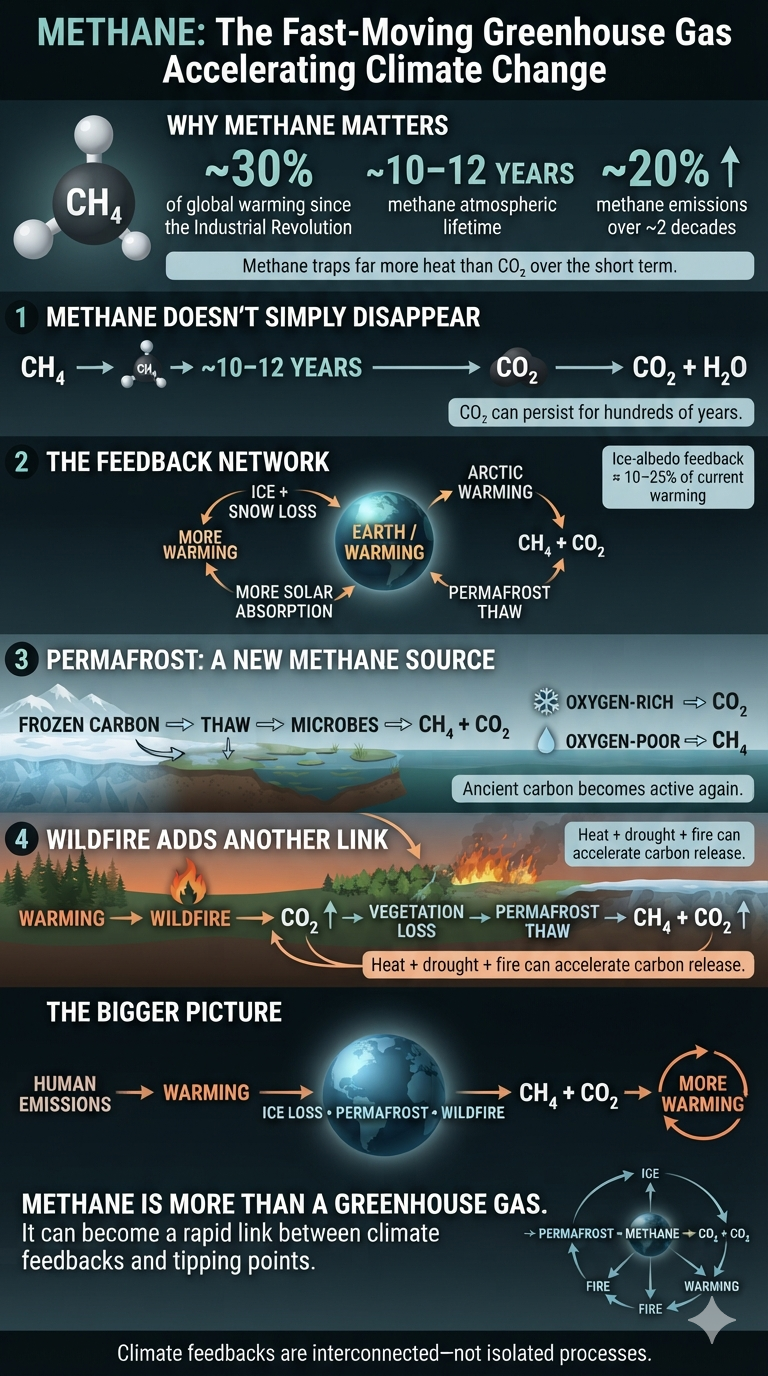
Methane has become a rapid link between climate feedbacks and tipping points.
Methane (CH₄), the primary component of natural gas, is one of the most powerful greenhouse gases driving modern climate change. Although methane remains in the atmosphere for only about a decade—far less time than carbon dioxide (CO₂)—it traps substantially more heat over short time horizons, making it a critical driver of near-term warming. Additionally, when methane is oxidized after roughly 10–12 years, its carbon is ultimately converted into CO₂, which can remain in the atmosphere and continue influencing the climate system for hundreds of years.
Methane is responsible for approximately 30% of the global warming experienced since the Industrial Revolution. It also contributes to longer-term warming because atmospheric methane is eventually oxidized primarily into carbon dioxide and water vapor. Water vapor is the most powerful amplifying feedback in the climate system, intensifying warming initiated by other greenhouse gases. When methane is burned as natural gas, its carbon is converted directly into CO₂, adding a long-lived greenhouse gas to the atmosphere.
Global methane emissions have increased dramatically over the past two decades, rising by roughly 20% and reaching record levels of approximately 610 million tonnes annually. The growing concern, however, is not simply the amount of methane being emitted by human activities. It is the increasing number of coupled climate feedbacks capable of generating additional methane as the planet warms.
One of the most important connections begins with the ice-albedo feedback. The ice-albedo effect is estimated to account for approximately 10–25% of current global warming. As snow and ice melt, darker land and ocean surfaces absorb more solar radiation rather than reflecting it back into space, amplifying regional and global warming. The ice-albedo feedback does not directly inject greenhouse gases into the atmosphere. Instead, its significance is that it can accelerate other processes that do.
Among the most important is permafrost thaw. Increasing Arctic temperatures are penetrating frozen soils that contain enormous quantities of ancient organic carbon. As permafrost thaws, previously frozen organic matter becomes accessible to microorganisms. Under oxygen-rich conditions, decomposition primarily produces CO₂. In saturated, oxygen-poor environments, however, microbial decomposition can produce methane (CH₄).
The result is a newly coupled climate feedback:
Ice and snow loss → greater solar absorption → Arctic warming → permafrost thaw → microbial decomposition → CH₄ + CO₂ → additional warming
This process is particularly concerning because permafrost thaw can occur much more rapidly than the millennial timescales often associated with gradual carbon release. Abrupt thaw, thermokarst formation, changing hydrology, and wildfire can accelerate the mobilization of previously frozen carbon over years to decades.
Wildfire adds another important connection. Increasing heat, drought, and changes in vegetation and fire weather are contributing to more severe and persistent wildfire conditions in some northern ecosystems. Fires release large quantities of CO₂ directly into the atmosphere while simultaneously removing vegetation and insulating organic layers that protect permafrost from summer heat.
In boreal regions of Canada and Siberia, this creates another powerful coupled feedback:
Warming → more severe wildfire → direct CO₂ emissions → loss of insulating vegetation and soil → accelerated permafrost thaw → additional CO₂ and CH₄ → further warming
The methane feedback therefore cannot be considered in isolation. It is increasingly embedded within a network of interacting climate feedbacks and tipping points.
As warming approaches and crosses critical thresholds, the climate system can shift from one dominated primarily by direct human greenhouse-gas emissions toward one in which natural feedbacks increasingly contribute additional greenhouse gases. Ice loss can accelerate permafrost thaw; permafrost thaw can increase methane and CO₂ emissions; wildfire can accelerate both atmospheric CO₂ accumulation and permafrost degradation; and the resulting warming can intensify the original processes.
The central concern is therefore not simply that methane emissions are increasing. It is that warming itself is increasingly activating new methane sources and strengthening existing feedbacks at the same time that other tipping points are being approached or crossed.
This creates a progressively more interconnected climate system:
Human emissions → warming → ice loss → permafrost thaw → methane and CO₂ release → more warming → greater wildfire and ecosystem disruption → additional greenhouse-gas release → further tipping-point pressure
Methane is consequently more than a powerful greenhouse gas. As climate tipping points become increasingly coupled, it can become a rapid amplifier linking physical, biological, and chemical feedbacks across the Earth system.
The Heat-Trapping Power of Methane
A Short-Lived but Extremely Powerful Greenhouse Gas
Methane has a unique climate profile:
| Characteristic | Raw Methane (CH4) | Combusted Methane (CO2) |
|---|---|---|
| Immediate Heat-Trapping Effect | Extremely high | Moderate |
| Global Warming Potential (20 years) | More than 80 times stronger than CO2 | Baseline |
| Atmospheric Lifespan | About 10–12 years | Centuries |
| Primary Climate Risk | Leaks, venting, and natural feedbacks | Long-term accumulation after combustion |
Because methane is so powerful in the short term, rapid methane reductions can have an immediate effect on slowing global warming. However, continued emissions create a dangerous cycle because warming itself can trigger additional natural methane releases.
Methane’s Two Pathways to Carbon Dioxide
A critical question is often overlooked when comparing natural gas combustion with methane emissions:
If methane eventually breaks down into carbon dioxide in the atmosphere, does allowing methane to escape ultimately produce the same amount of CO₂ as burning it?
In terms of carbon atoms, essentially yes. One molecule of methane (CH₄) contains one carbon atom. Whether that methane is burned immediately or eventually oxidized in the atmosphere, that carbon can ultimately become approximately one molecule of CO₂.
But the climate consequences are dramatically different because of the pathway and timing.
1. Combustion: Immediate Conversion to CO₂
When methane is burned in a power plant, furnace, stove, engine, or flare, the conversion occurs almost immediately:
CH₄ + 2O₂ → CO₂ + 2H₂O
The carbon in methane is converted directly into carbon dioxide.
The climate consequence is therefore dominated by long-lived CO₂, which remains in the atmosphere and affects the climate system for centuries or longer.
But combustion also eliminates methane’s period of extremely strong short-term heat trapping.
2. Atmospheric Oxidation: Methane First, CO₂ Later
When methane escapes directly into the atmosphere, it does not immediately become CO₂.
Instead, atmospheric chemistry gradually oxidizes methane, primarily through reactions involving hydroxyl radicals (OH). The process occurs through a series of intermediate chemical reactions before the carbon ultimately becomes CO₂.
Methane has an atmospheric lifetime of roughly a decade, meaning that a large fraction of an emission is removed from the atmosphere over approximately 10–12 years.
During that period, however, the methane itself is an exceptionally powerful greenhouse gas.
The sequence is therefore:
Methane leak → approximately 10–12 years of intense methane warming → atmospheric oxidation → CO₂ → centuries of additional warming
This creates a crucial distinction:
Burning methane converts it to CO₂ immediately.
Leaking methane delays the CO₂ conversion—but adds a period of extremely powerful methane warming first.
That is why preventing methane leakage can produce a disproportionately large near-term climate benefit.
Why the Carbon Source Matters
The eventual conversion of methane into CO₂ does not mean that all methane emissions have identical climate consequences.
The critical distinction is where the methane’s carbon came from.
Fossil Methane: Adding Ancient Carbon
Methane extracted from natural gas and other fossil fuel deposits contains carbon that has been isolated from the active atmosphere-biosphere carbon cycle for millions of years.
When fossil methane is:
- burned, its carbon becomes CO₂ immediately;
- leaked, its carbon initially produces powerful methane warming and is then largely converted into atmospheric CO₂.
Either way, fossil methane represents a net transfer of geological carbon into the active atmosphere-climate system.
Biogenic Methane: Carbon Cycling Through the Biosphere
Methane produced by livestock, wetlands, and other biological processes is different.
Much of this methane originates from carbon that plants recently removed from atmospheric CO₂ through photosynthesis.
The simplified cycle is:
Atmospheric CO₂ → Plants → Organic matter → Methane → Atmospheric CO₂
This is part of the short-term biological carbon cycle, rather than the introduction of ancient fossil carbon.
That distinction, however, does not make biogenic methane harmless.
Methane can produce substantial warming during the decade or so that it remains in the atmosphere. Its eventual return to CO₂ does not erase that temporary but powerful climate forcing.
The Key Distinction
The important question is therefore not simply:
“Does methane eventually become CO₂?”
It does.
The more important questions are:
“What happens before it becomes CO₂?”
and
“Where did its carbon come from?”
That distinction explains why methane is such a critical climate-control target.
Fossil methane:
Ancient carbon → methane leak → intense near-term warming → CO₂ → long-term warming
Biogenic methane:
Atmospheric CO₂ → plants → methane → intense near-term warming → CO₂
The chemistry may ultimately return methane’s carbon to CO₂, but the climate system experiences the methane phase first—and that phase is extraordinarily powerful.
Major Sources of Methane Emissions
Methane emissions come from both human activities and natural systems.
1. Fossil Fuel Production and Use
The fossil fuel industry remains one of the largest sources of human-caused methane emissions.
Major sources include:
- Oil and natural gas extraction: methane leaks during drilling, processing, storage, and transportation.
- Coal mining: methane trapped in coal seams escapes during extraction.
- Natural gas infrastructure: pipelines, compressors, and storage facilities can release large quantities of methane.
Despite industry commitments to reduce leakage, global fossil fuel methane emissions remain near record levels, estimated at roughly 120–150 million tonnes annually.
Recent tracking shows:
- Oil operations contribute approximately 45 Mt/year of methane emissions.
- Coal mining contributes approximately 43 Mt/year.
- Natural gas systems contribute approximately 36 Mt/year.
Satellite observations have also identified frequent “super-emitter” events, where enormous methane releases occur from individual facilities, coal mines, and aging oil fields.
2. Agriculture and Waste
Human activities account for the majority of long-term methane growth.
Livestock Production
Ruminant animals such as cattle and sheep produce methane through digestion. Their manure also releases methane when stored in oxygen-poor conditions.
Agriculture contributes approximately 35–40% of human-caused methane emissions, driven largely by:
- Expanding cattle and dairy production.
- Increased global demand for meat and dairy products.
- Manure management systems.
Landfills and Organic Waste
Modern waste systems create ideal methane-producing conditions.
When food waste and other organic materials are buried in landfills, they decompose without oxygen, producing methane that can escape into the atmosphere.
Rapid urbanization and rising consumption have increased landfill methane emissions worldwide.
3. Natural Methane Feedback Loops
One of the most concerning developments is that climate change itself is beginning to increase methane emissions from natural systems.
Warming Wetlands: A Climate Feedback Loop
Tropical wetlands have become a major contributor to the recent acceleration in atmospheric methane growth.
The mechanism:
Rising temperatures → Increased rainfall and flooding → Expansion of oxygen-poor wetlands → Faster microbial decomposition → Increased methane release → Additional warming
Research from NOAA and the University of Colorado indicates that tropical wetlands, especially in South America and Africa, have become dominant sources of the recent methane surge.
Wetlands accounted for approximately 40% of the increase in methane emissions between 2000 and 2022, demonstrating how climate change can activate self-reinforcing feedback loops.
Methane Emissions Are Accelerating
Global methane emissions have increased dramatically over the past two decades, rising by roughly 20% and reaching record levels of approximately 610 million tonnes annually.
Atmospheric monitoring from organizations including NOAA and the International Energy Agency (IEA) shows methane concentrations continuing a steep upward trend.
This acceleration is being driven by three interacting forces:
- Expanding fossil fuel extraction and infrastructure leaks.
- Growing agricultural and waste emissions.
- Climate-driven natural feedback loops, especially warming wetlands.
Why Methane Matters for Climate Stability
Methane represents one of the fastest opportunities to slow near-term warming because it has such a powerful short-term climate impact.
Reducing methane emissions from:
- Fossil fuel leaks,
- Livestock systems,
- Landfills,
- and industrial operations
could rapidly reduce the rate of warming.
However, continued warming threatens to unlock additional natural methane emissions from wetlands, permafrost, and other carbon-rich ecosystems. These feedbacks create the risk of a self-reinforcing cycle:
More warming → More methane release → More greenhouse warming → More ecosystem disruption → More methane release
Methane is therefore not only a pollutant—it is a critical indicator of whether Earth’s climate system is moving toward stabilization or accelerating disruption.
The Growing Methane Feedback: From Ice-Melt Acceleration to Tipping-Point Amplification
The ice-albedo feedback is one of the fastest climate feedbacks operating today. As Arctic sea ice and snow cover disappear, darker surfaces absorb more solar energy, accelerating regional warming.
But the climate system does not stop at the ice-albedo feedback.
As warming crosses additional thresholds, carbon-cycle feedbacks can become increasingly important—and methane can become a powerful amplifier of that warming.
This creates a critical transition in the climate system:
Ice loss accelerates warming → warming destabilizes frozen carbon stores → microbial activity increases → methane emissions increase → methane adds additional warming → more tipping points become vulnerable
The significance of methane is therefore not limited to today’s emissions. Its greater danger may lie in the possibility that warming itself progressively activates new methane sources.
1. Permafrost: A Gateway to Additional Methane
Permafrost contains enormous quantities of frozen organic carbon accumulated over thousands of years.
While frozen, much of this carbon remains relatively isolated from microbial decomposition. As temperatures rise and permafrost thaws, previously frozen organic material becomes available to microorganisms.
The resulting greenhouse-gas emissions depend on local conditions.
In oxygen-rich soils, decomposition produces primarily CO₂.
In saturated, oxygen-poor soils and wetlands, anaerobic decomposition can produce substantial quantities of methane (CH₄).
The feedback therefore becomes:
Warming → permafrost thaw → microbial activation → CH₄ release → additional warming
The important point is that permafrost thaw can turn a previously inactive carbon reservoir into an increasingly active source of greenhouse gases.
2. Why Methane Becomes More Important as Warming Accelerates
Methane is especially important because it is an extremely powerful greenhouse gas over short timescales.
When methane emissions increase, the atmosphere experiences a rapid additional warming influence. Although methane eventually oxidizes into CO₂, its initial warming effect is much stronger than that of an equivalent amount of CO₂ over the first several decades.
This makes methane particularly important during periods when the climate system is approaching or crossing tipping points.
The sequence can become:
Initial warming → methane release → rapid additional warming → greater probability of crossing another threshold
Once another tipping system begins to destabilize, it can generate additional warming or greenhouse-gas emissions of its own.
3. Tipping Points Can Transform the Methane Feedback
The importance of methane should therefore be considered as part of a network of interacting tipping points, rather than as an isolated feedback.
For example:
Arctic warming
↓
Sea-ice loss
↓
Ice-albedo feedback strengthens
↓
Additional Arctic warming
↓
Permafrost thaw increases
↓
Microbial decomposition accelerates
↓
CH₄ emissions increase
↓
Additional atmospheric warming
↓
Further ice loss and permafrost thaw
This network can become even more complicated as other climate thresholds are approached.
Warming can alter precipitation patterns, increase wildfire activity, change Arctic hydrology, and transform previously frozen or oxygen-rich soils into waterlogged environments where methane production becomes more favorable.
Consequently, the methane feedback can strengthen not simply because temperatures rise, but because warming changes the physical conditions controlling where and how methane is produced.
4. From External Forcing to Internal Amplification
This distinction is fundamental.
At the beginning of anthropogenic warming, the primary forcing comes from human emissions of greenhouse gases.
But as warming increases, the climate system itself can begin generating additional greenhouse-gas emissions.
The system moves progressively from:
Human emissions → warming
toward:
Human emissions → warming → feedback activation → additional greenhouse gases → additional warming
Methane is particularly important in this transition because it can provide a rapid amplification mechanism inside a much slower carbon-cycle response.
Permafrost does not need to release all of its stored carbon to become climatically important. Even a progressively increasing methane contribution can amplify warming during the critical period when other tipping points are becoming increasingly vulnerable.
5. Methane as a Tipping-Point Multiplier
This is why the methane feedback should not be evaluated solely by comparing today’s methane emissions with today’s CO₂ emissions.
The more important question is:
Does continued warming activate new methane sources that were previously largely dormant?
If the answer is yes, methane changes from being primarily an emissions-control problem into an increasingly important Earth-system feedback problem.
The distinction can be summarized as:
Before tipping-point activation:
Human emissions → methane emissions → warming
As tipping points are crossed:
Human emissions → warming → permafrost and wetland changes → additional methane → more warming
With multiple interacting tipping points:
Warming → ice loss → greater solar absorption → permafrost thaw → methane release → additional warming → further tipping-point activation → additional greenhouse-gas release
This is the critical danger.
The climate system does not have to experience one enormous methane release for the feedback to matter. A progressively increasing methane contribution, coupled with other feedbacks, can help push the system across additional thresholds.
The Emerging Climate Dynamic
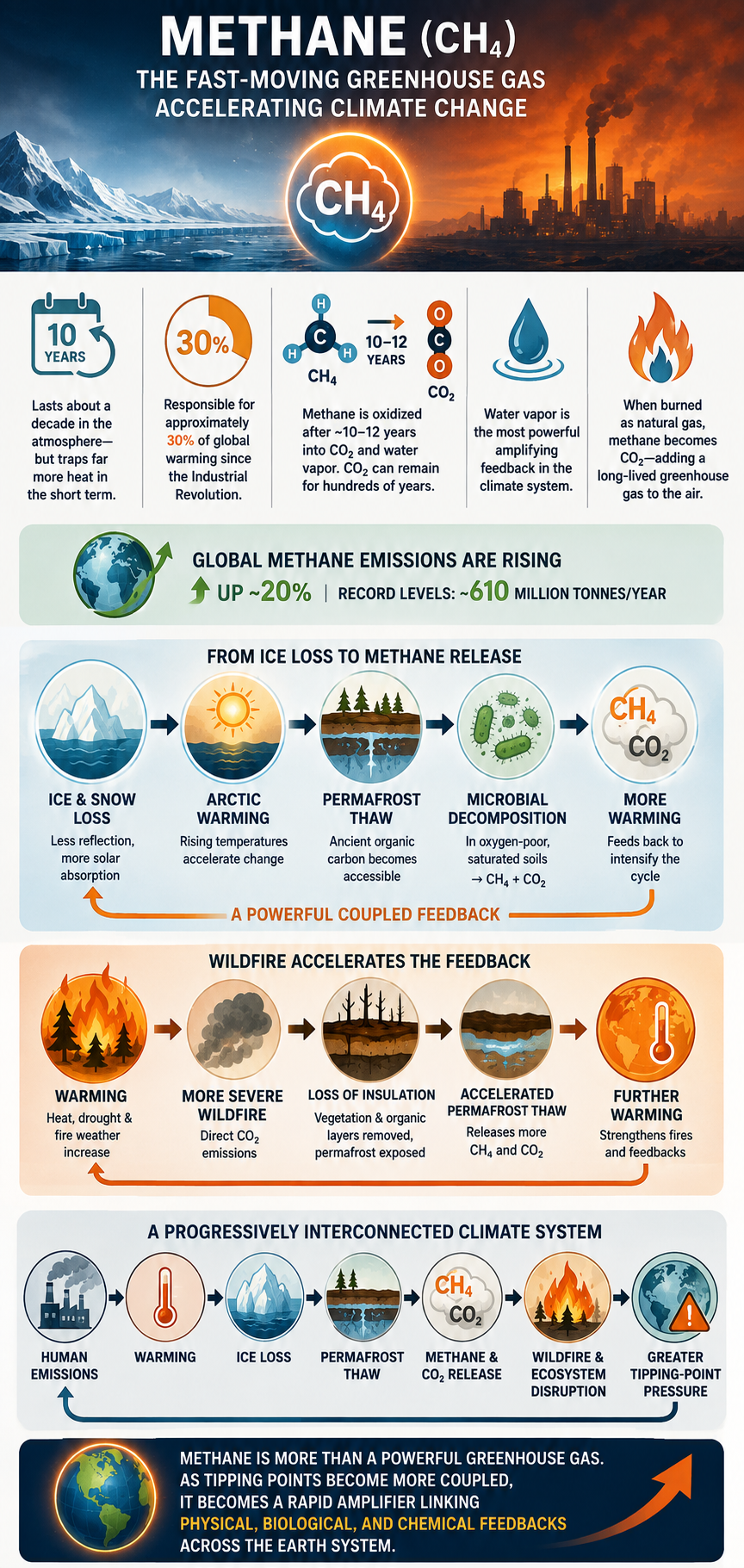
The ice-albedo feedback may be one of the fastest visible accelerators of Arctic warming today.
But as warming continues, the relative importance of methane-producing feedbacks can increase because previously frozen carbon becomes biologically active and environmental conditions become increasingly favorable for methane production.
The resulting system can be viewed as a progression:
Warming → ice loss → greater solar absorption → permafrost thaw → methane + CO₂ release → more warming → intensified wildfires → forest and soil carbon loss → accelerated permafrost thaw → additional greenhouse-gas release → further tipping-point activation
The critical issue is therefore not whether methane will suddenly become the dominant driver of climate change.
It is whether methane feedbacks become an increasingly important amplifier at precisely the time when the climate system is becoming more vulnerable to cascading tipping points.
That possibility makes methane one of the most important short-term feedbacks to monitor as the planet moves deeper into a warmer and increasingly nonlinear climate state.
Links Between Climate Feedbacks and Tipping Points
Polar amplification → weakened equator-to-pole temperature gradients → reduced thermal contrast → atmospheric circulation changes → accelerated Arctic and Greenland ice melt → ICE–ALBEDO FEEDBACK: ice loss → darker surface → greater solar absorption → more warming → more ice loss ↺ → MELT–ELEVATION FEEDBACK: ice loss → lower ice-sheet elevation → warmer air → faster surface melt → further elevation loss ↺ → LAPSE-RATE FEEDBACK: Arctic warming → weaker vertical temperature gradient → reduced atmospheric cooling efficiency → additional near-surface warming → more ice melt ↺ → coupled cryospheric amplification → freshwater input into the North Atlantic → reduced salinity + density → AMOC disruption / potential weakening → North Atlantic pressure-field + storm-track reorganization → greater jet-stream waviness → slower progression → amplified Rossby waves → persistent blocking + omega blocks + meridional flow → stalled atmospheric rivers + prolonged heat domes + drought–flood swings → hydroclimatic whiplash → agriculture + infrastructure + ecosystems + public health stress → PERMAFROST TIPPING ELEMENT: thaw → CO₂ + CH₄ release → additional greenhouse forcing → Arctic warming ↺ → BOREAL FOREST TIPPING ELEMENT: warming + drought + wildfire → forest degradation → reduced carbon uptake + carbon release → additional warming ↺ → AMAZON RAINFOREST TIPPING ELEMENT: warming + drought + fire → reduced evapotranspiration + rainfall recycling → greater drought → forest loss + carbon release → additional warming ↺ → WEST ANTARCTIC ICE-SHEET TIPPING ELEMENT: ice instability → accelerated ice loss → sea-level rise → additional cryospheric stress → global land-ice loss + groundwater redistribution → planetary mass redistribution → altered moment of inertia → rotational dynamics → slight rotational slowing → changes in length of day.
Also see:
- The Arctic Amplification Engine
- The Ice–Albedo–Melt–Elevation Feedback: Earth’s Most Powerful Cryospheric Tipping-Point Mechanism
- Arctic Amplification: Arctic Heat, Wildfires, and the Accelerating Loss of Earth’s Ice
Extreme Impacts: Extreme Weather Events | Violent Rain | Deadly Humid Heat | Sea Level Rise | Insurance
Ecosystems & Feedbacks: Ecosystem Collapse & Extinction Risks | Soil–Insect Climate Feedback Collapse | Insect Collapse | Soil | Trees & Deforestation
Human Health & Society: Climate Change Business & Economics | DIY Climate Control | Climate & Human Health | Climate Tax | Limits of Human Adaptability | Climate-Driven Health Collapse | Food & Water Security | Civilization Collapse