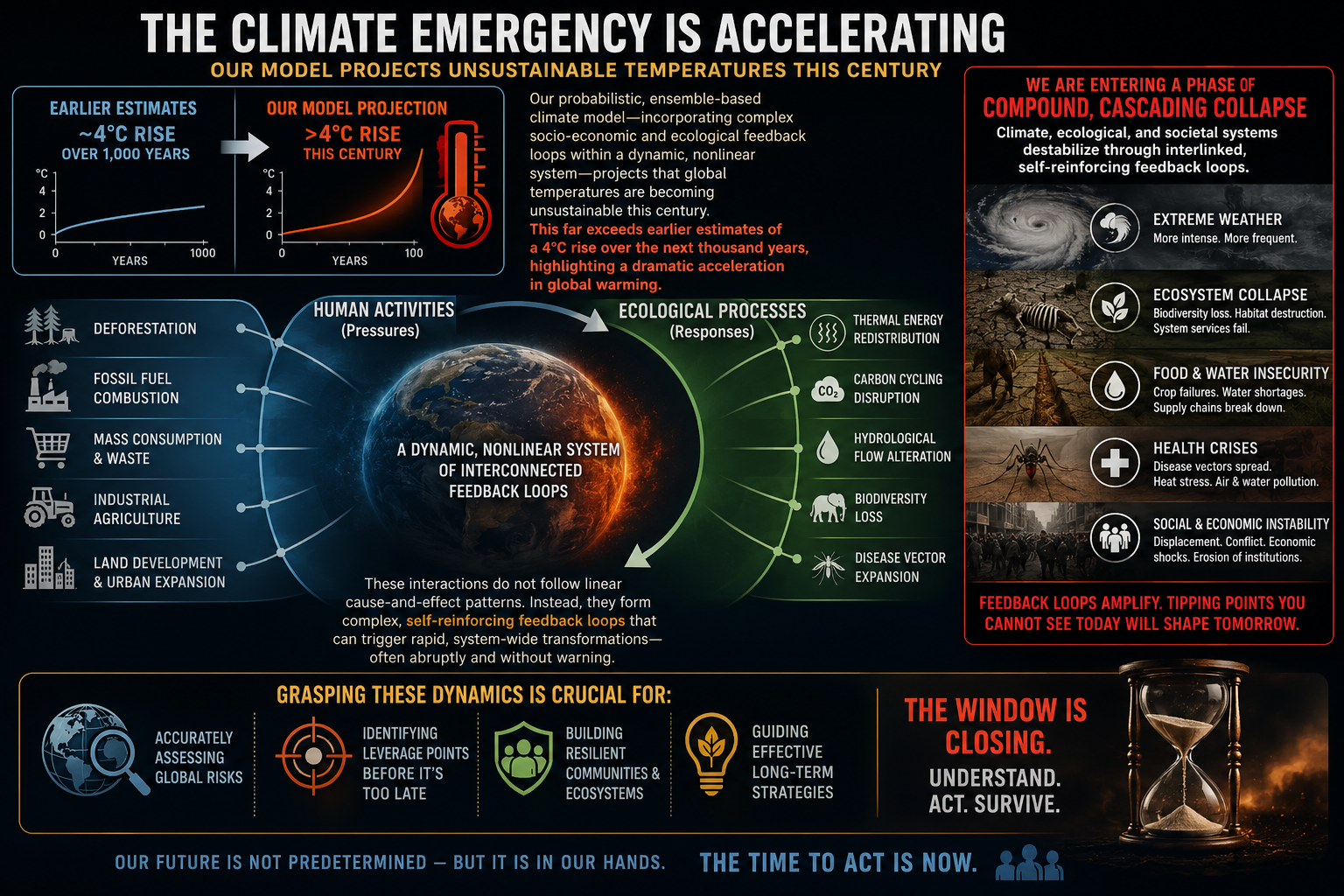
Water Vapor + Clouds: Coupled Feedbacks Driving a Warmer Planet
Introduction
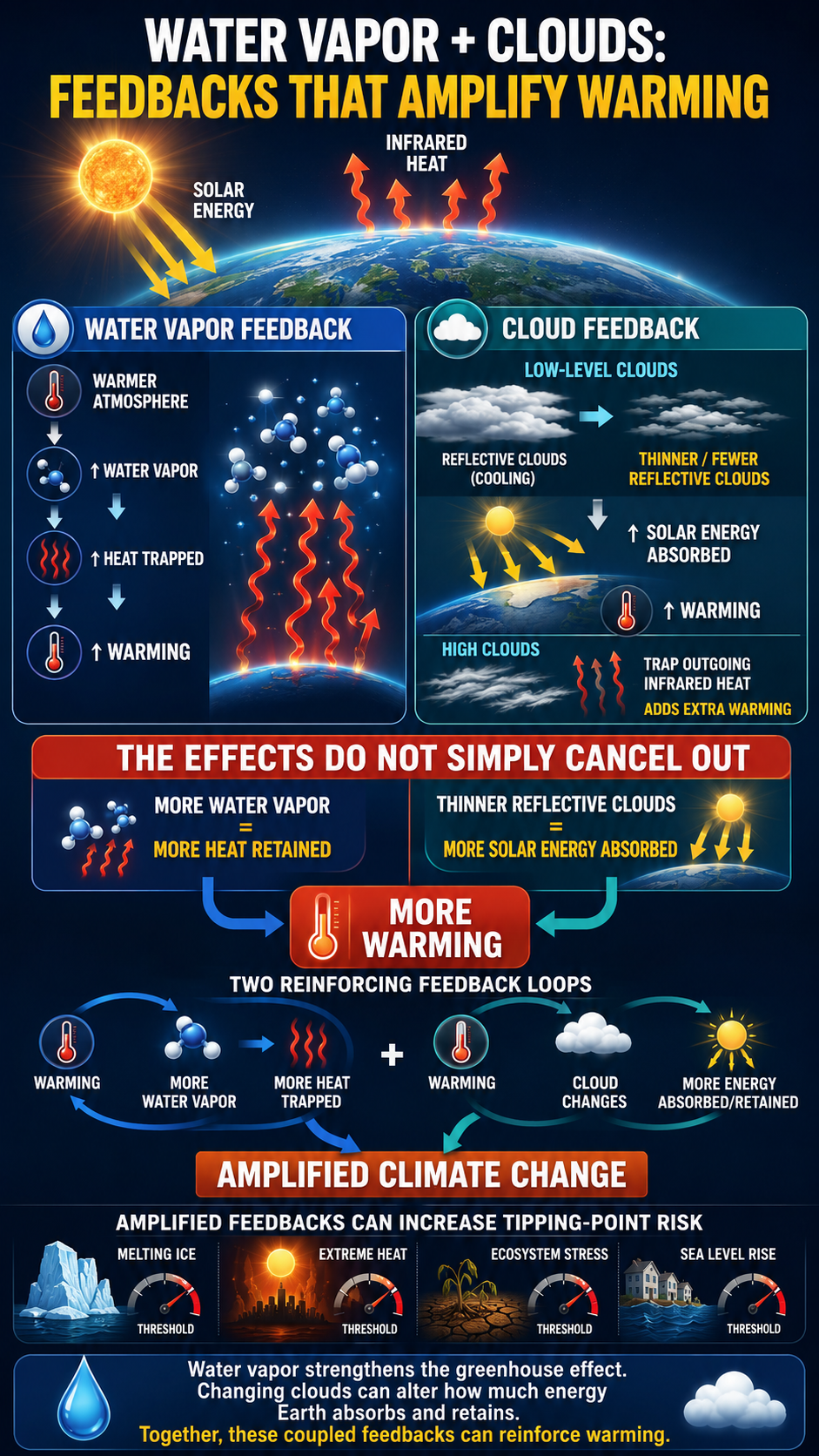
Water vapor is Earth’s most abundant and most potent natural greenhouse gas. As the climate warms, atmospheric water vapor increases, strengthening the greenhouse effect.
Clouds are different. Climate change is altering their amount, altitude, thickness, reflectivity, lifetime, and geographic distribution—changing how much solar energy is reflected and how much infrared heat is retained.
Individually, these feedbacks are amplifying warming. Together, their interactions can reinforce climate change, intensify climate-system responses, and increase the potential for multiple tipping points to interact and amplify one another.
Water vapor is Earth’s most abundant and most important natural greenhouse gas. As the climate warms, the atmosphere can hold more water vapor, creating a powerful positive feedback: warming increases atmospheric moisture, and that additional water vapor traps more heat, causing additional warming. Under the Clausius-Clapeyron relationship, the atmosphere can hold roughly 7% more water vapor for every 1°C of warming, provided sufficient moisture is available.
Clouds, by contrast, have competing effects. Low clouds generally cool the planet by reflecting incoming sunlight back into space, while high clouds generally warm it by trapping outgoing infrared radiation. But this does not mean that their effects are currently neutral or cancel each other out.
The critical question is not simply whether clouds cool during the day and warm at night. It is how climate change is altering the amount, altitude, thickness, reflectivity, lifetime, and geographic distribution of different cloud types.
Current evidence indicates that these changes are producing a net climate feedback that does not simply cancel out the warming influence of increased greenhouse gases and water vapor. In particular, reductions or thinning of some highly reflective low-level clouds can allow more solar energy to reach the Earth’s surface, amplifying warming.
Water Vapor: A Powerful Positive Feedback
Unlike carbon dioxide, water vapor is primarily a feedback rather than the initial forcing responsible for today’s long-term warming.
As carbon dioxide and other greenhouse gases warm the atmosphere, warmer air can contain more moisture. That additional water vapor absorbs outgoing infrared radiation and strengthens the greenhouse effect.
This creates a reinforcing cycle:
More greenhouse gases → warming → more atmospheric water vapor → stronger greenhouse effect → additional warming.
Water vapor also contributes to changes in precipitation, atmospheric rivers, extreme rainfall, and other aspects of the hydrological cycle.
Clouds: Their Effects Do Not Simply Cancel
Clouds are more complicated than water vapor because they can exert both cooling and warming influences.
Low-level reflective clouds, such as stratocumulus, tend to cool the climate by reflecting incoming sunlight back into space.
High-level clouds, such as cirrus, tend to warm the climate because they allow much of the Sun’s shortwave radiation to enter while reducing the amount of infrared heat that escapes to space.
It is therefore tempting to assume that the cooling effect of clouds during the day is roughly canceled by their warming effect at night. That is not an adequate description of the changing climate system.
Cloud feedback depends on far more than the day-night cycle. It depends on:
- cloud altitude
- cloud thickness
- cloud coverage
- cloud reflectivity
- cloud lifetime
- geographic location
- underlying surface conditions
- atmospheric temperature and humidity
- changes in atmospheric circulation
Climate change is altering these characteristics. Consequently, the cooling and warming effects of clouds are not remaining in a fixed equilibrium.
The relevant issue is the change in the balance.
If highly reflective low clouds become less extensive or thinner, more solar radiation reaches the ocean and land surface. At the same time, persistent or changing high clouds can continue to restrict the escape of infrared radiation.
The result is not a neutral cloud system. Some observed and modeled cloud changes act as positive feedbacks that add to global warming.
Why Changes in Low Clouds Matter
One of the most important climate questions is how global warming changes the abundance, thickness, altitude, and distribution of clouds—particularly low-level marine clouds.
Several mechanisms can alter these clouds.
Declining Relative Humidity
A warmer atmosphere can contain substantially more water vapor without necessarily becoming more saturated.
In some regions, changes in circulation and surface conditions can therefore produce lower relative humidity and less favorable conditions for cloud formation.
The result can be fewer or thinner clouds even while the total amount of atmospheric water vapor increases.
This illustrates an important distinction:
More water vapor does not necessarily mean more clouds.
Water vapor can increase the atmospheric greenhouse effect while conditions become less favorable for the formation or persistence of certain reflective clouds.
Cleaner Air and Reduced Aerosols
Air pollution produces aerosols that can serve as cloud-condensation nuclei, providing particles around which cloud droplets can form.
Successful reductions in sulfur dioxide and other particulate pollution have produced major public-health and environmental benefits. However, removing reflective aerosols can also remove some of the cooling that previously offset greenhouse warming.
The interaction between declining aerosol pollution, cloud formation, and climate is complex and varies geographically.
Changes in Atmospheric Circulation
Climate change is also altering atmospheric circulation patterns.
Changes in subtropical circulation, storm tracks, ocean temperatures, and atmospheric stability can shift where clouds form and how long they persist.
These changes can affect the distribution and characteristics of reflective low clouds and potentially amplify warming.
The Cloud Feedback
The basic relationship can be summarized as follows:
| Cloud type | Typical direct effect | Climate-change concern |
|---|---|---|
| Low-level clouds | Reflect sunlight → cooling | Reductions or thinning allow more solar energy to reach the surface |
| High-level clouds | Trap outgoing heat → warming | Changes in altitude and properties can increase heat retention |
| Middle-level/mixed clouds | Can produce both effects | Impact depends on altitude, thickness, and composition |
The key distinction is this:
Clouds have both cooling and warming effects, but climate change is changing the balance between those effects.
Therefore, saying that clouds “cool during the day and warm at night” does not establish that their overall climate impact is neutral.
A cloud system can have a net cooling effect today while simultaneously undergoing changes that reduce that cooling effect and thereby produce a positive cloud feedback.
This is an important distinction between cloud forcing and cloud feedback.
Clouds have historically produced a substantial net cooling influence on the climate. But if warming causes reflective low clouds to decrease or become less reflective, the planet loses some of that cooling. The resulting change itself constitutes an additional warming influence.
Regional Exceptions Matter
Cloud behavior is not uniform across the planet.
For example, the rapidly changing Arctic climate produces complex regional cloud responses as sea ice retreats and previously ice-covered ocean becomes exposed. Open water changes evaporation, atmospheric moisture, aerosols, and surface energy exchange. Marine biological activity can also influence atmospheric particles that participate in cloud formation.
Thus, even when a broad global tendency exists, regional cloud feedbacks can move in different directions.
The existence of regional exceptions does not mean that cloud feedback is neutral globally. It means that the climate system is heterogeneous and that different mechanisms can dominate in different locations.
The Bigger Picture
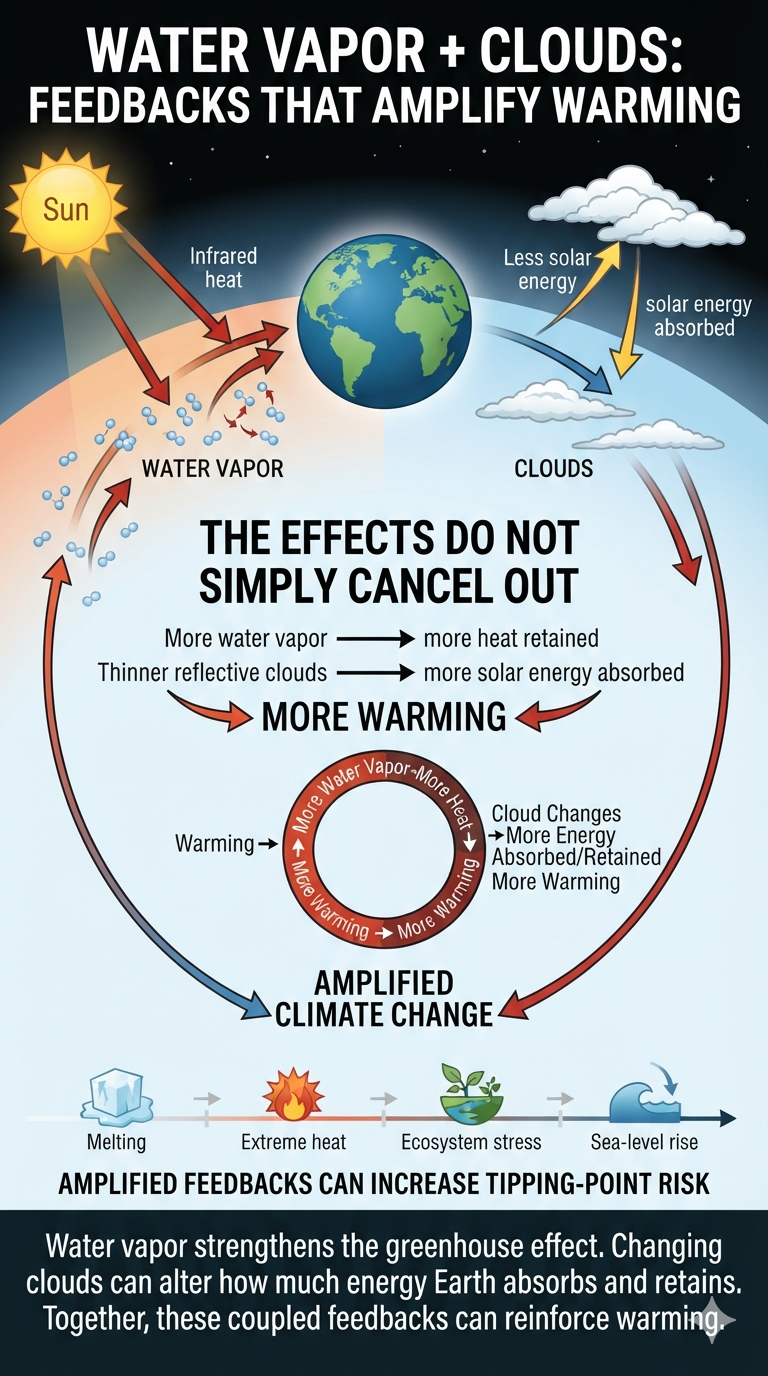
The key point is that water vapor and clouds should not be treated as interchangeable parts of the climate system.
Water vapor is a powerful greenhouse gas whose atmospheric concentration increases as the climate warms, providing a major positive feedback.
Clouds are different. They redistribute energy through both solar reflection and infrared heat trapping. But the balance between those effects is not fixed.
Climate change is modifying the cloud system itself and appears to be a positive feedback accelerating climate change.
This matters because the climate system responds to changes in Earth’s energy balance. Even a relatively small persistent shift toward greater absorption of solar energy or reduced escape of infrared radiation can accumulate over time.
Water vapor strengthens the greenhouse effect, while changing cloud behavior can alter how much additional energy the Earth absorbs and retains. Together, these coupled feedbacks can reinforce warming, accelerate climate-system changes, and increase the risk of triggering or amplifying tipping points.
Extreme Impacts: Extreme Weather Events | Violent Rain | Deadly Humid Heat | Sea Level Rise | Insurance
Ecosystems & Feedbacks: Ecosystem Collapse & Extinction Risks | Soil–Insect Climate Feedback Collapse | Insect Collapse | Soil | Trees & Deforestation
Human Health & Society: Climate Change Business & Economics | DIY Climate Control | Climate & Human Health | Climate Tax | Limits of Human Adaptability | Climate-Driven Health Collapse | Food & Water Security | Civilization Collapse